Hey all, sorry for the long hiatus. Such is life with a busy summer. I’m hoping to get these back on track a bit, though they will be slower for at least the next few weeks in all likelihood. However, with that being said, let’s get back on track with some of the more eerie Pokemon introduced in Generation 1, and a flagship member of the Psychic type: the Alakazam family.

Beginning with Abra, it’s a fairly innocuous and cute design that leans more than most seen in the first generation into looking off. Abra looks like a whole bunch of mammals and simultaneously not much like anything at all, with a design that effectively blends whimsical charm and a slight creepiness to it. Abra is said to sleep for 18 hours a day and is known to immediately use Teleport to flee at the first sign of danger, something that I certainly find a lot to love about as an endearing personality for it. While undoubtedly frustrating to catch, this does a very good job of making Abra immediately desirable to catch for people to figure out what its deal is, and while Teleport is the only move it learns by level up, this seemingly helpless creature holds one of the highest Special Attack stats of any unevolved Pokemon. Whether you can get a TM to make it shine or just baby it until it evolves, hinting at its psychic power being unleashed with adequate training is a valuable design choice. I think there may be an argument for this being the best of its evolution line, which isn’t something I say about most not fully evolved Pokemon. It’s pretty close between them but Abra has a charm that makes the family what it is, but isn’t quite replicated.
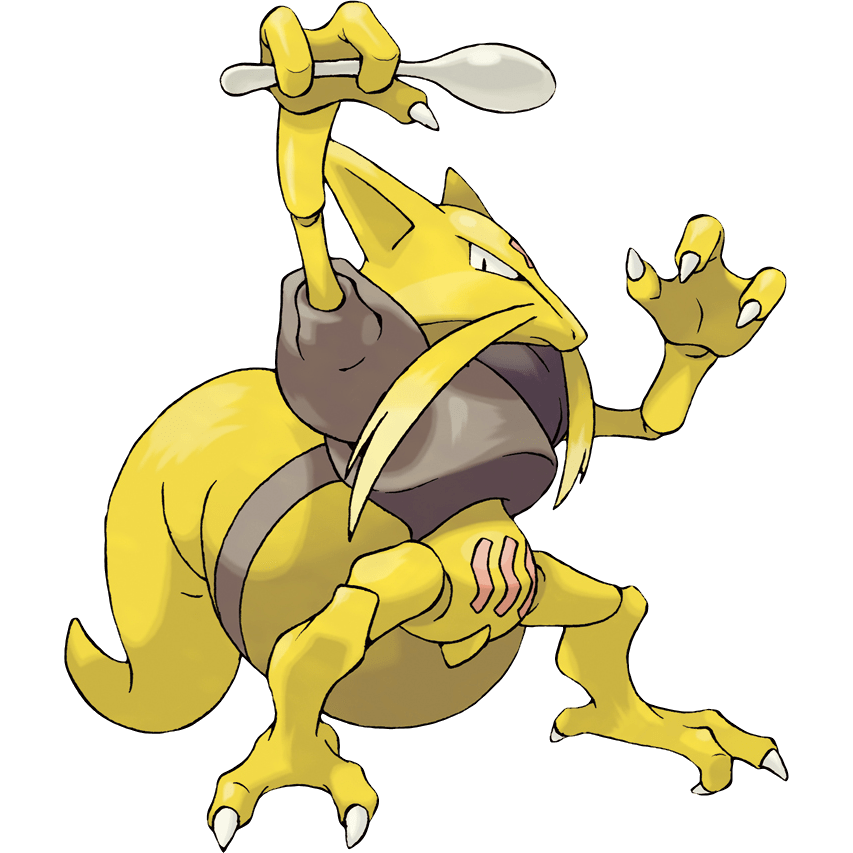
Kadabra, in a move that is both ideal and disappointing, drops a lot of Abra’s charm as an ineffectual, skittish baby and leans more into the creepy elements of its design. It abandons any pretense of being cute or cowardly and now projects the image of a focused, fierce telekinetic brimming with psychic power. Kadabra leans quite heavily into a loose spattering of occult imagery: its spoon-bending technique, star marking, and bizarre abdominal zigzags pair well with its gangly form that uses its large head and tail as an effective contrast to look skinnier. Kadabra is definitely the member of this evolution line trying the least to look flattering, which did also make it arguably the worst one to be named after a real person (though all three members of the family do this). The recently dropped lawsuit by Uri Geller has definitely plagued Kadabra’s ability to appear in spinoff media, most notably the TCG that it was absent from for nearly two decades, but fortunately this seems to have resolved amicably in recent years. Away from the sensationalist idea of psychic powers in real life though, Kadabra is more than a legitimate force in the world of Pokemon, and while it’s a far cry from my favourites I think this creepy mammalian creature does a very good job of making the Psychic type just plain weird and scary, with its own flavour of cool a lot of Pokemon don’t go for.
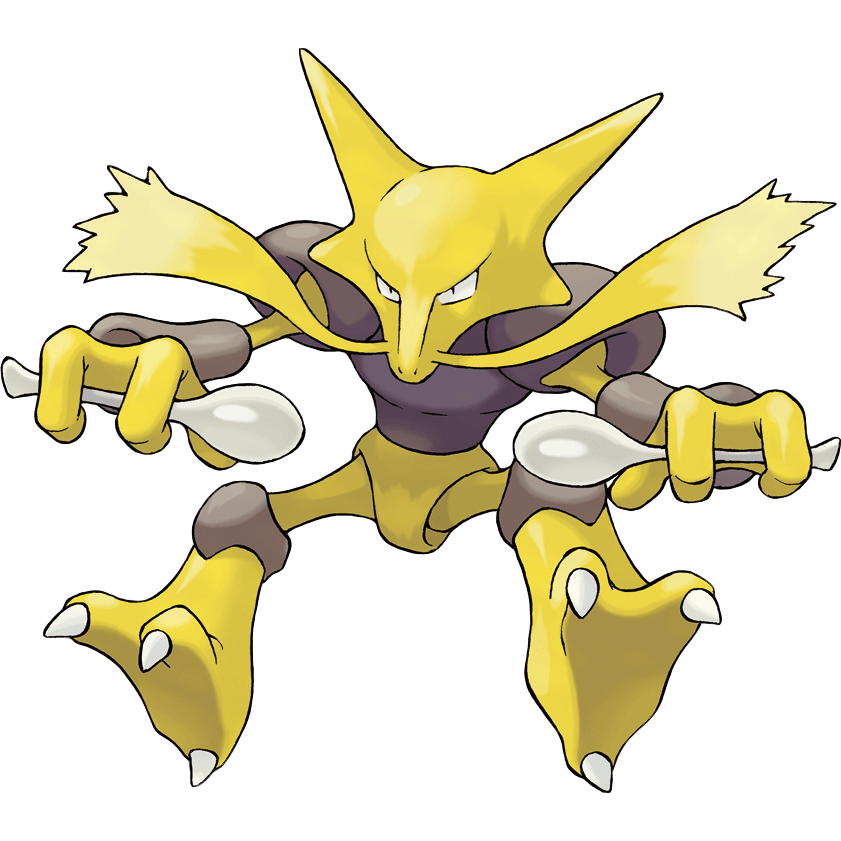
Appropriately named, this evolution line ends with Alakazam: the first of the four trade evolutions of Generation 1 and a competitive demon who is almost as synonymous with the overbearing power of the Psychic type in Red and Blue as Mewtwo. The most obvious thing about Alakazam is that it seems to focus on cleaning up and refining Kadabra’s design to project the image of a more focused, disciplined psion than a bedraggled occultist. In some ways I think this is a bit of a shame as I quite like Kadabra’s more freakish elements, but the double spoons, more distinctive head and moustache, and added brown padding do make for something a little more cohesive at least so whether that’s a good thing is unclear. At the very least, sudden shifts in design to make the Pokemon look sleeker appear to be a common trend among all four of the Kanto trade evolutions, so I do wonder if it’s intentional. In fact, I find myself still seeing Alakazam, Machamp, Golem, and Gengar as some kind of elite, prestigious group among Kanto Pokemon: it’s interesting to see how they’ve diverged over the years but something about them all as a group has a lot of charm. One thing I really do not like about Alakazam, unfortunately, is the stark gender differences added in Generation 4. Diamond and Pearl added quite a lot of minor variations of sexual dimorphism for older Pokemon, and while most of the adjustments for Sinnoh Pokemon are fine and feel purposefully designed, those that were added as retcons overwhelmingly skew towards a very sloppy “female Pokemon have smaller versions of the most distinctive physical feature” and Alakazam suffers by far the most: tragically losing more than half its grand moustache. That’s a real shame for an otherwise pretty solid Pokemon, but I can’t deny there’s still a lot to love. I think it has been eclipsed by many Psychic types in the years since its introduction, and to be honest I find its colour scheme a little too drab for it to really grab me aesthetically, but points for trying.

Back to another Pokemon that can transcend its limits with Mega Evolution: we finally have Mega Alakazam. I’ll start with the positives: purple is always a welcome addition to a design. The drab brown pieces all over its body now look more purposeful and evoke elements of a wizard’s robe in the sleeve-like designs. Additionally, I do like the concept of it becoming physically weaker as it centres itself so heavily around enhanced psychic power. Of course, I can’t talk about it without acknowledging the jokes about its five spoons demolishing hordes of Vanillite mercilessly, which I do find quite funny. With all that being said, however, I just don’t think I like this design very much. I’ll admit my bias right away: I find it outrageous in competitive play from how fast and strong it is, particularly in draft league where it’s just obscene in strength and power. I don’t think I particularly like the beard either: the flowing white hair is a logical step but it doesn’t mesh well with the rest of the colours, and I like Alakazam’s head shape a lot more than its Mega Evolution which just appears to go for a star-like skull rather than the distinct, almost goat-like structure. Lastly, the five spoons sadly just feel a little tacked on. As a display of power they work, but I liked them more firmly grasped as a psychic weapon or focus, rather than the backdrop they’ve become. Overall, this is one of the least interesting Mega Evolution designs in my view.
Final Verdict: 6/10 – a solid and experimental psychic design, but aesthetically a little plain and held back somewhat.
Mega Alakazam Final Verdict: 4/10 – iterates on Alakazam in some interesting ways, but loses a lot of the original charm and gets a little too messy.
 Floral Valiant's Poké-Pandemonium